 FlowPIE
Scientific idea generation (SIG) is critical to AI-driven autonomous research, yet existing approaches are often constrained by a static retrieval-then-generation paradigm, leading to homogeneous and insufficiently divergent ideas. In this work, we propose FlowPIE, a tightly coupled retrieval–generation framework that treats literature exploration and idea generation as a co-evolving process. FlowPIE expands literature trajectories via a flow-guided Monte Carlo Tree Search (MCTS) inspired by GFlowNets, using the quality of current ideas assessed by an LLM-based generative reward model (GRM) as a supervised signal to guide adaptive retrieval and construct a diverse, high-quality initial idea population. Based on this population, FlowPIE models idea generation as a test-time idea evolution process, applying selection, crossover, and mutation with the isolation island paradigm and GRM-based fitness computation to incorporate cross-domain knowledge. It effectively mitigates the information cocoons arising from over-reliance on parametric knowledge and static literature. Extensive evaluations demonstrate that FlowPIE consistently produces ideas with higher novelty, feasibility and diversity compared to strong LLM-based and agent-based frameworks, while enabling reward scaling during test time.
Idea Generation Framework
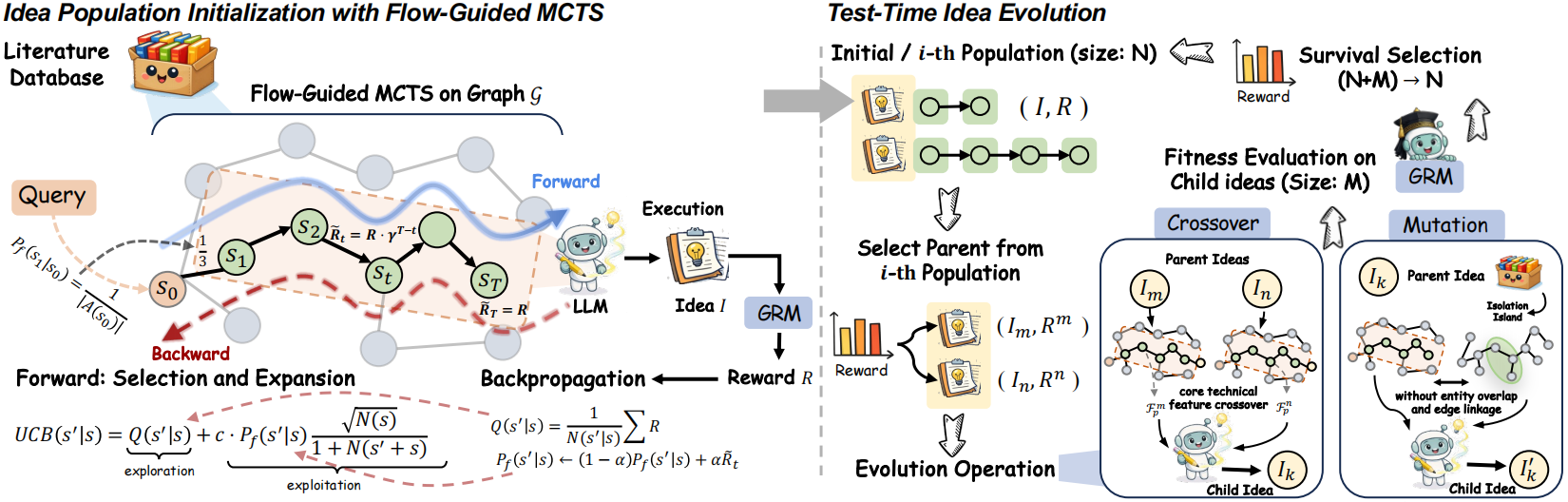
In this work, we propose FlowPIE, a tightly coupled retrieval–generation framework for test-time idea evolution, as illustrated in the following Figure. Moving beyond the traditional static retrieval paradigm, FlowPIE unifies literature retrieval and idea generation into a dynamic and adaptive test-time idea evolution process. Within this process, intermediate generated ideas serve as active feedback to guide subsequent literature exploration. Specifically, it performs structured exploration over the literature subgraph by modeling the retrieval as a flow-guided MCTS inspired by GFlowNets, thereby incrementally expanding retrieval trajectories in both breadth and depth.
The ideas generated along these paths are then organized into an initial population for subsequent iterative evolution. FlowPIE is implemented as an evolutionary algorithm that operates over this idea population through the iterative application of selection, crossover, and mutation operators, with fitness evaluated via LLM-based generative reward model (GRM). During the mutation stage of the evolutionary process, FlowPIE specifically introduces the isolation island paradigm. This paradigm maintains multiple isolated literature, thereby facilitating the incorporation of cross-domain knowledge and diverse literature characteristics.
@article{wang2026flowpie,
  title={FlowPIE: Test-Time Scientific Idea Evolution with Flow-Guided Literature Exploration},
  author={Wang, Qiyao and Wang, Hongbo and Chen, Longze and Yang, Zhihao and Chen, Guhong and Alinejad-Rokny, Hamid and Li, Hui and Lin, Yuan and Yang, Min},
  journal={arXiv preprint arXiv:2603.29557},
  year={2026}
}